What's the inmost force which binds the world, and guides its course?

"That (sic) I may know what holds the world together at its core" - This quote from Goethe's Faust from the early 19th century shows that the question of the nature of the fundamental building blocks of the world played a major role in people's lives long before the advent of modern physics. With the development of revolutionary theories such as quantum physics and the advancement of technical developments over the last 100 years, research into and understanding of the smallest particles has continued to progress. Astonishing findings have been made in this field in recent years in particular. One prominent example is the Higgs boson, which was discovered in 2012 at CERN, one of the best-known research centres for particle physics.
In this area, young and old can immerse themselves in the microscopic world of particles. You can try out various experiments that modern physics uses to get to the bottom of this microcosm.
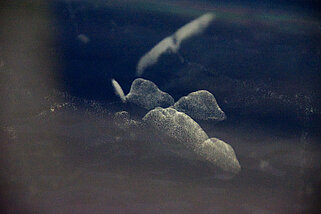
0.0000000000000001 metres. This is the order of magnitude of the diameter of an atomic nucleus. How can such tiny objects be made visible? One impressive way is the cloud chamber. When certain particles move through vaporised liquid, they leave trails behind them, just as an aircraft leaves trails of condensation. You can track them down yourself here. |
| Interaction |  |
Brain power |  | ||
Physical effort |  |
From Geneva to Rome in 3 milliseconds. This is roughly the speed of a particle accelerator. In order for the particles to reach this speed, they have to be repeatedly pushed along a circular path at the right moment. The faster they are, the smaller the time window in which this push must take place. |
| Interaction |  |
Brain power |  | ||
Physical effort | |
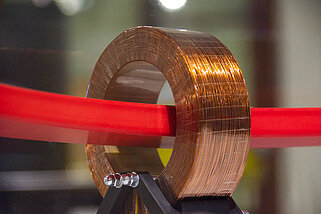
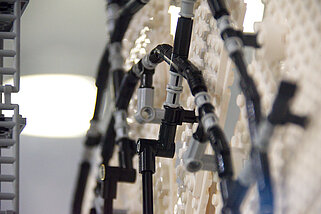
How big does a device have to be to discover the smallest building blocks in the world? The answer is: huge! At least if you want to obtain detailed information about their composition and behaviour. The ATLAS detector is one of these devices. It actually consists of several devices, each of which detects different types of particles. Take a look at its inner workings here and realise the scale of the model compared to reality! |
| Interaction | |
Brain power | | ||
Physical effort | |