Is everything relative?

"Everything is relative."
Albert Einstein (1879 - 1955) is famous for these words. However, they were not actually said by Einstein, but were simply misunderstood by a journalist. But what does this quote actually mean? What did the world-famous physicist with the tousled hair discover that made him so famous? Trace the effects of Einstein's revolutionary theories in this section. Find out how space and time behave when moving at approximately the speed of light. Discover other phenomena described by Einstein, such as the photoelectric effect and the trembling motion of small particles in water.
In this area you will find 4 exhibits that illustrate the wide range of Albert Einstein's research:
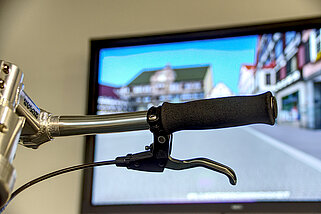
In his special theory of relativity, Einstein investigated the effects of movement at approximately the speed of light. In the everyday world, the things we see move at a snail's pace by comparison. What effects would you observe if you raced through the universe (or a pedestrian zone) almost as fast as light? Step on the pedals and find out for yourself here! Will you manage to reach the speed of light? |
| Interaction |  |
Brain power |  | ||
Physical effort |  |
What is a black hole? How do we know about the Big Bang? And what does this have to do with a solar eclipse? All these questions can be answered with Einstein's general theory of relativity. A central component of this theory is the curvature of space and time by extremely large masses such as stars. Observe this curvature by placing small celestial bodies in the gravitational field of a super-heavy object. In which orbits do they move in the funnel? |
| Interaction | |
Brain power |  | ||
Physical effort | |
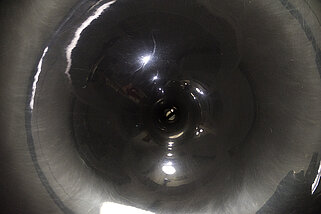
On the one hand, Einstein dealt with unimaginably large objects in his theory of relativity; on the other hand, he made important contributions to the physics of the smallest particles with his calculations on the movement of molecules. How do particles such as air molecules move in a confined space? What influence does temperature have on this movement? Find out for yourself here! |
| Interaction | |
Brain power | | ||
Physical effort | |
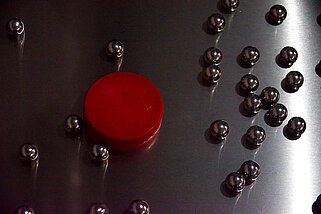
What does a beam of light consist of? In physics, light can be described in two ways. Like sound, light is a wave. At the same time, light also consists of particles. At first, only the wave character of light was known. Later, the particle character of light was also proven, primarily through Einstein's interpretation of the photoelectric effect. He even received the Nobel Prize for this. In this exhibit you can carry out the decisive experiment yourself. |
| Interaction | |
Brain power | | ||
Physical effort | |